
From lab to space: One of the first TriPleX® photonic integrated circuits in orbit
To realize a novel photonic sensing system, based on a TriPleX® photonic chip, for future planetary exploration, from the lab to a TU Delft-built satellite for an in-orbit demonstration. That is the mission of two teams at TU Delft’s Faculty of Aerospace Engineering, which are joining forces for the first time. One develops miniature satellites; the other works on advanced photonic chips to search for signs of life.
Start of the European search for extraterrestrial life
About 20 years ago, we developed the Life Marker Chip originally for ESA to detect molecular signatures associated with life on Mars. The development continued to find daily life applications on Earth, and today the chip is used for advanced diagnostics in the biomedical industry by our partner SurfiX. Now, this technology is being further developed for future missions that could search for signs of life in ocean worlds such as Enceladus, one of Saturn’s moons. Although ExoMars ultimately never flew, the technology and consortium never disappeared.
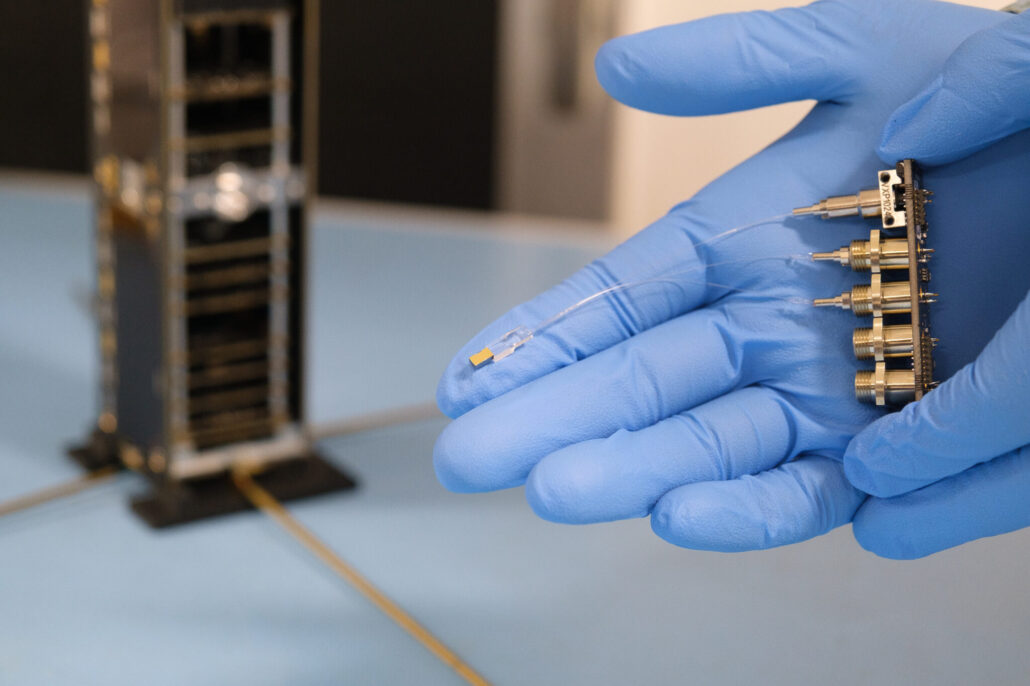
The PRISM payload with the asymmetric Mach-Zehnder Interferometer photonic chip, laser, and photodiode, together with the Delfi-Connect satellite bus it will fly on.
LioniX has been involved in the Life Marker Chip since the beginning. Building on its experience in photonic integrated circuits, microfluidics, and MEMS, we are developing the integrated photonic technology needed for the next generation of compact life detection instruments.
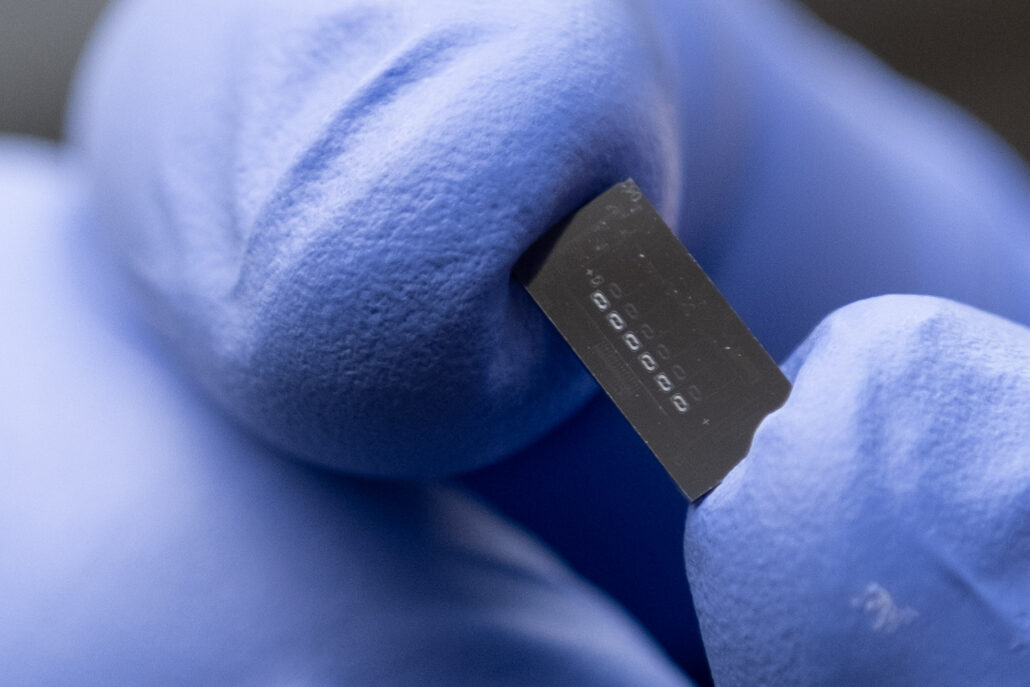
The TriPleX® photonic chip at the heart of the mission.
The role of LioniX International: Developing the TriPleX® photonic chip
The photonic chip at the heart of the Life Marker Chip for origin of life (LMCOOL) programme will be tested in space for the first time, as part of an upcoming TU Delft PocketQube mission. The project is supported by the Netherlands Space Agency (NLSA).
At the center of the mission is a TriPleX® photonic chip called PRISM (PocketQube Refractive Index Sensing Module). This chip technology forms the core of the Life Marker Chip (LMCOOL), which is being developed to detect molecules such as amino acids by measuring tiny changes in the refractive index of liquids. That is where we provide our expertise and develop the PRISM hardware.
Testing life-detection technology in space
The next step is to test how this photonic sensor performs in space. While many aspects of space systems can be simulated on Earth, reproducing the full space environment remains impossible.
“In space, PRISM will measure how stable the sensor is under real conditions,” says Planetary exploration researcher Dr Niels Ligterink. “We will monitor how factors such as temperature changes and radiation affect the system over time.”
By recording these effects, researchers can show that the technology works in orbit and better understand how it behaves in the space environment. For LMCOOL, this is a crucial milestone. It will increase its technology readiness level (TRL), a key requirement for future missions to destinations such as icy moons.
Taking a TriPleX® photonic chip from cleanroom to orbit
To test the chip in space, it needed a platform. That is where the Delfi programme comes in. Based at the Faculty of Aerospace Engineering, it offers a rare opportunity for the LMCOOL project.
“PocketQubes are ideal for testing new technologies like this,” says Dr Stefano Speretta of TU Delft’s Space Systems Engineering section. “They allow us to bring early-stage innovations into space quickly and at relatively low cost. Because we develop the platform in-house, we can also adapt it to new payloads more easily. This would be much harder to achieve through external providers.
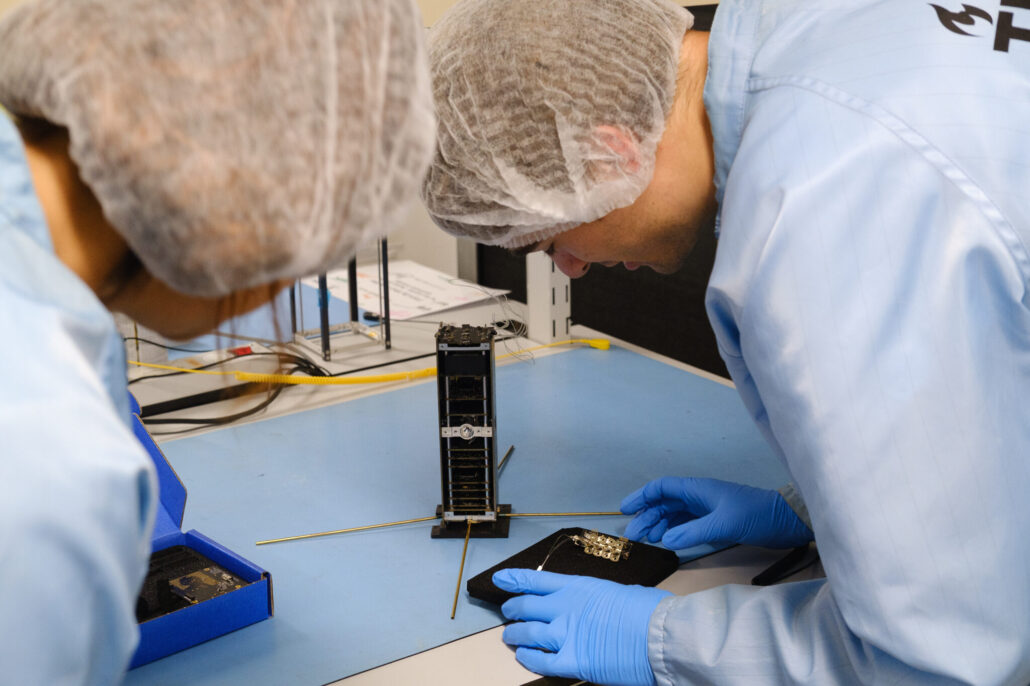
TU Delft team members Vidhya Pallichadath and Bavo Vlyminckx working with the components.
This is an important step towards using this technology in both Earth orbit and deep-space exploration. It also positions the Netherlands as a frontrunner in photonics-enabled space instrumentation.
“This mission is set to be among the first demonstrations of TriPleX®, a Dutch silicon nitride (SiN) photonic chip, in space,” says René Heideman, Senior Business Developer at LioniX International. “Together, we are paving the way for future missions in which photonic chips will play a central role.”
Looking ahead
With Delfi and PRISM, TU Delft demonstrates how research can move from laboratory concept to space-based validation using in-house expertise and national partnerships. The launch, currently planned for early 2027, will mark the next milestone.
The timeline is ambitious: from the first idea to launch in just ten months. By building, testing, and flying new technologies quickly, researchers and students gain valuable experience. It leaves little room for certainty, but real-world experimentation is often the fastest route to better technology.
More information
TU Delft’s full press release: https://www.tudelft.nl/en/2026/lr/from-lab-to-space-tu-delft-led-mission-to-test-photonic-chip-in-orbit
ESA’s Exomars (Life Marker Chip) Mission story: https://www.lionix-international.com/mems/mems-solutions/life-marker-chip/
Get in contact


